Introduction
School security has changed dramatically across Queensland in recent years. Consequently, the humble intercom at the front gate has evolved from a simple buzzer into a fully integrated access control and emergency communication platform. For school administrators, business managers, and facilities teams across Brisbane, this shift is no longer optional — it is becoming an operational baseline.
An intercom Brisbane system designed for educational environments does far more than let office staff answer the front door. It controls visitor flow, creates an auditable record of every entry, integrates with lockdown protocols, and allows staff to manage multiple entry points simultaneously from a single location. Moreover, it does all of this without adding headcount or disrupting the rhythm of a busy school day.
This guide covers everything Brisbane schools need to know before specifying or upgrading their entry system in 2026.
Why Brisbane Schools Are Prioritising Entry Control Right Now
Security incidents at Australian schools have risen steadily over the past three years. Additionally, Queensland’s Department of Education has progressively tightened its visitor management requirements for state schools, placing the burden of implementation on individual school facilities teams. For independent and Catholic schools, governance bodies are similarly raising compliance expectations around entry documentation and access control.
Beyond compliance, however, the practical challenge is straightforward. Most Brisbane school campuses were designed for a different era — one where office staff could see the front gate from the reception desk and physically recognise most visitors. That model no longer reflects the reality of how modern schools operate. Larger campuses, busier rosters, open days, after-hours hire, and delivery logistics have made manual visitor management genuinely unworkable at most sites.
Furthermore, the growing number of parents, contractors, and community groups accessing school grounds outside core hours has created entry points that nobody is consistently monitoring. An intercom Brisbane system with video verification closes that gap directly — without requiring staff to be physically present at every entry point throughout the day.
What Makes a School Entry System Different From a Standard Intercom
Most residential and commercial intercom systems are designed around a single entry point and a small number of users. School environments are fundamentally different, and the specifications need to reflect that.
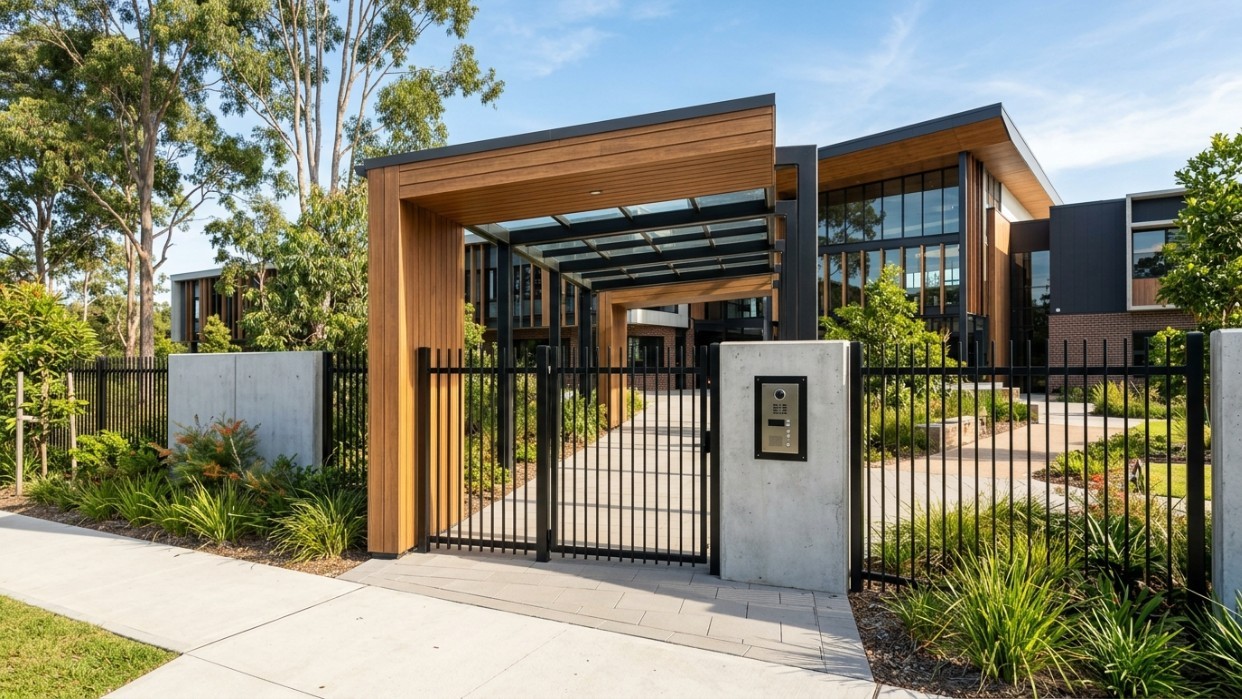
Firstly, multi-point entry management is essential. Most Brisbane school campuses have at least three to five distinct entry points — a main pedestrian gate, a vehicle entry, a hall or gym entrance, and one or more secondary pedestrian access points. A system that only manages one of these creates a false sense of security, because determined unauthorised visitors simply use the unmonitored gate.
Secondly, high call volume resilience matters more than most buyers realise. During morning drop-off and afternoon pickup — typically between 7:45am and 8:30am, and again between 2:45pm and 3:30pm — intercom systems at busy Brisbane primary schools can receive 40 to 80 calls in under an hour. Systems without call queuing, auto-answer capability, or multi-station forwarding create bottlenecks that frustrate parents and overwhelm office staff.
Thirdly, evidence capture and audit trail is increasingly required. When an incident occurs — whether a custody dispute, an unauthorised entry, or a contractor accessing the wrong area — school leaders need a time-stamped record of who entered and when. IP-based systems with local or cloud storage provide this automatically. Analogue systems provide nothing at all.
Finally, integration with existing communication infrastructure is critical for cost-effective deployment. As highlighted in our Access Technologies Compared article, SIP-based systems can connect directly to the school’s existing phone system, enabling calls from the front gate to ring through to the office handsets staff already use — no additional monitors required.
The Case for IP-Based Systems Over Analogue in Queensland Schools
Many Brisbane schools still operate ageing analogue intercoms installed during original construction — systems that are 15 to 25 years old, running on proprietary wiring, and increasingly impossible to repair when components fail. The shift to IP-based systems represents a meaningful upgrade in every functional dimension.
IP systems run over the school’s existing data network using Power over Ethernet (PoE). Therefore, they do not require dedicated intercom wiring runs throughout the campus — a significant cost reduction for sites where new cable installation is disruptive or expensive. In heritage buildings and campus environments with constrained ceiling access, this advantage alone often justifies the transition.
Additionally, IP-based systems are software-configurable rather than hardware-limited. Adding a new entry point to an analogue system typically means running new cabling back to the central panel and purchasing additional proprietary hardware. Adding a new entry point to an IP system, by contrast, means plugging a new PoE-powered door station into the nearest network switch — a task completed in hours rather than days.
Remote management is another meaningful difference. School business managers can adjust access schedules, add or remove keycards, review entry logs, and update system configurations from any device on the network. During school holidays, after-hours hire coordination, and special events, this flexibility is genuinely valuable. According to Queensland Department of Education guidelines, schools are expected to maintain documented access management processes — something an IP system supports automatically through its built-in audit trail.
Visitor Management: The Feature Most Schools Underestimate
Of all the capabilities a modern intercom Brisbane system offers educational environments, visitor management integration is the one most consistently underestimated during the specification process — and the one that delivers the greatest day-to-day operational benefit.
A basic video intercom allows staff to see and speak to a visitor before releasing the gate. That is already a substantial improvement over an audio-only buzzer. However, purpose-built IP systems with facial recognition capability go considerably further. When integrated with a visitor management platform, they can automatically flag visitors whose access has been revoked, alert nominated staff when specific individuals present at any gate, and generate real-time notifications for after-hours entries.
For Brisbane independent schools in particular, where parent populations are large and staff turnover is relatively low, pre-registered facial recognition access for known community members significantly reduces the administrative burden on office staff during peak periods. Parents with regular legitimate access — sports coaches, music tutors, reading volunteers — can be registered once and thereafter enter without requiring staff intervention for every visit.
Moreover, RFID card access for staff and contractors provides a complementary layer that removes the manual verification burden entirely for authorised personnel. As covered in our 7 Intercom Installation Mistakes article, mixing access methods — facial recognition for known visitors, video verification for unknowns, RFID for staff — is the configuration that consistently performs best in high-traffic institutional environments.
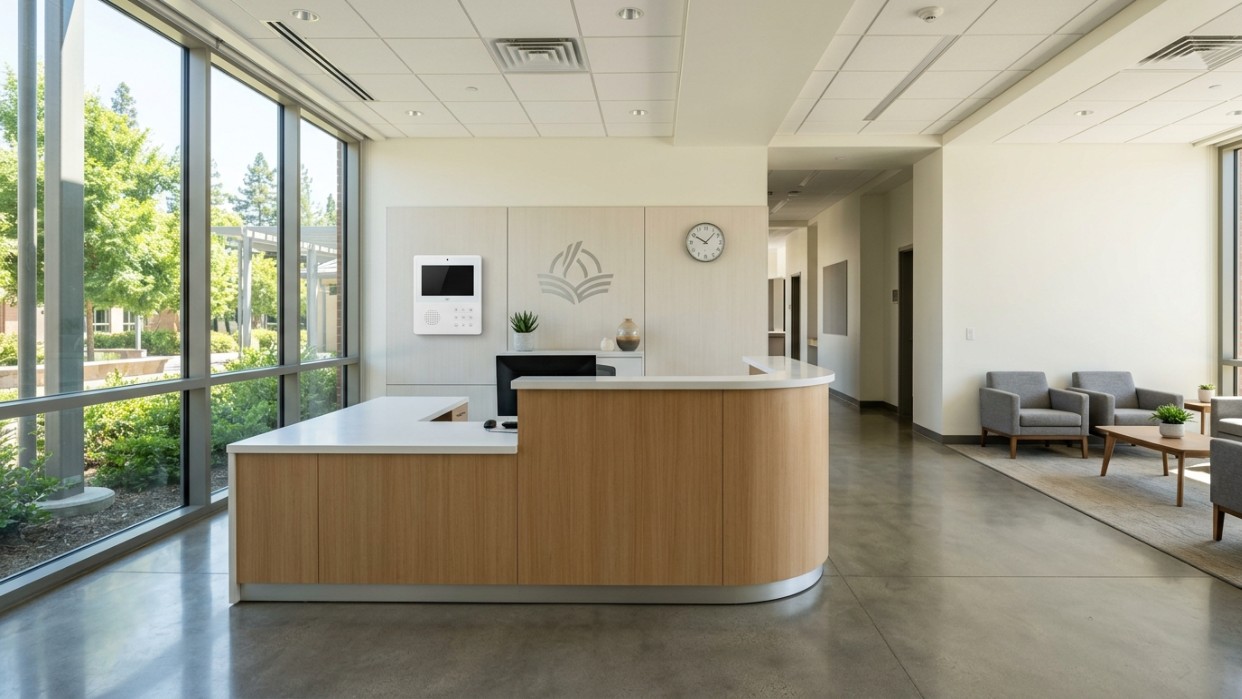
Emergency Communication: What Brisbane Schools Need to Plan For
Beyond daily access management, the emergency communication capability of an intercom Brisbane system has become a critical consideration for Queensland school facilities planning. A well-specified IP system supports lockdown initiation, zone-based announcements, and two-way communication between the office and any external entry point — capabilities that analogue systems simply cannot provide.
Specifically, SIP-based IP intercom systems can be configured to trigger a site-wide alert from any authorised handset or door station on the network. During a lockdown event, staff do not need to be at the main office to initiate communication protocols — they can do so from any classroom phone or indoor monitor connected to the same SIP platform.
Additionally, two-way audio between the office and all external entry points allows staff to communicate directly with emergency services at the gate without physically opening the door or leaving a secure area. This capability is particularly valuable for schools with perimeter fencing and a single controlled entry point — a design increasingly common in newer Brisbane school builds.
For campuses with multiple buildings across a larger footprint, zone-based paging through the same IP infrastructure allows targeted announcements to specific areas rather than site-wide broadcasts — reducing confusion and enabling more nuanced emergency communication protocols.
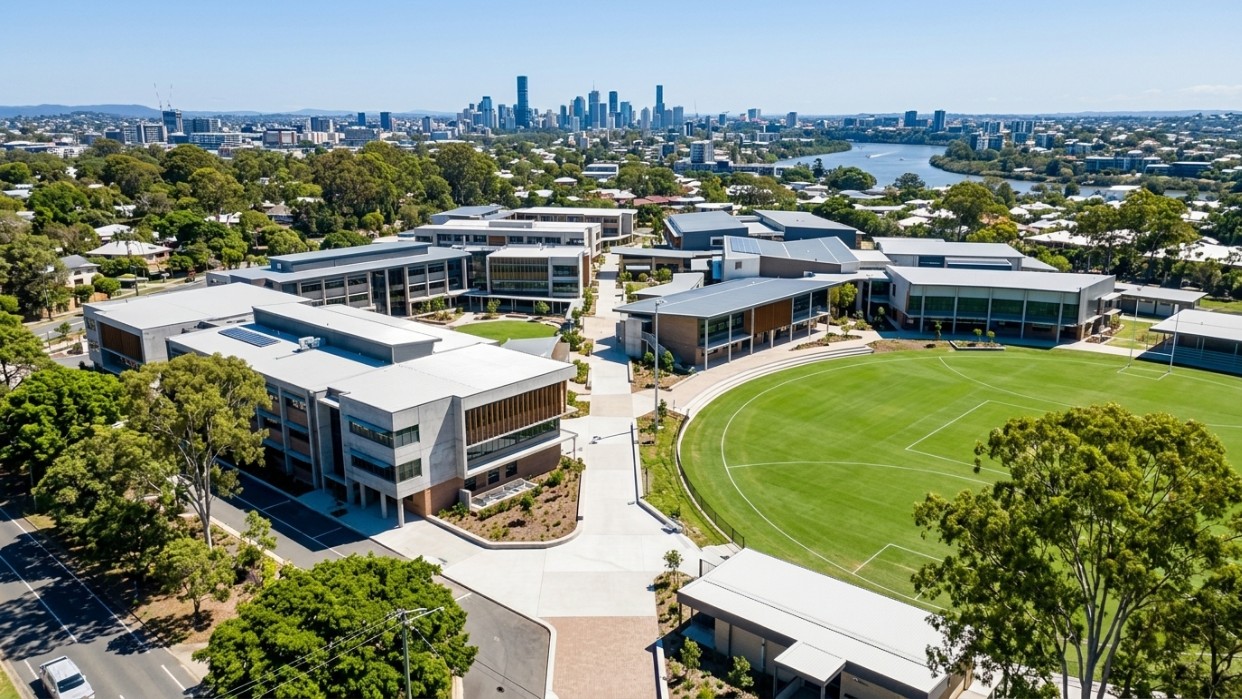
Practical Considerations for Brisbane School Deployments
Every school campus presents unique physical and operational constraints. However, several practical considerations apply consistently across Brisbane educational deployments.
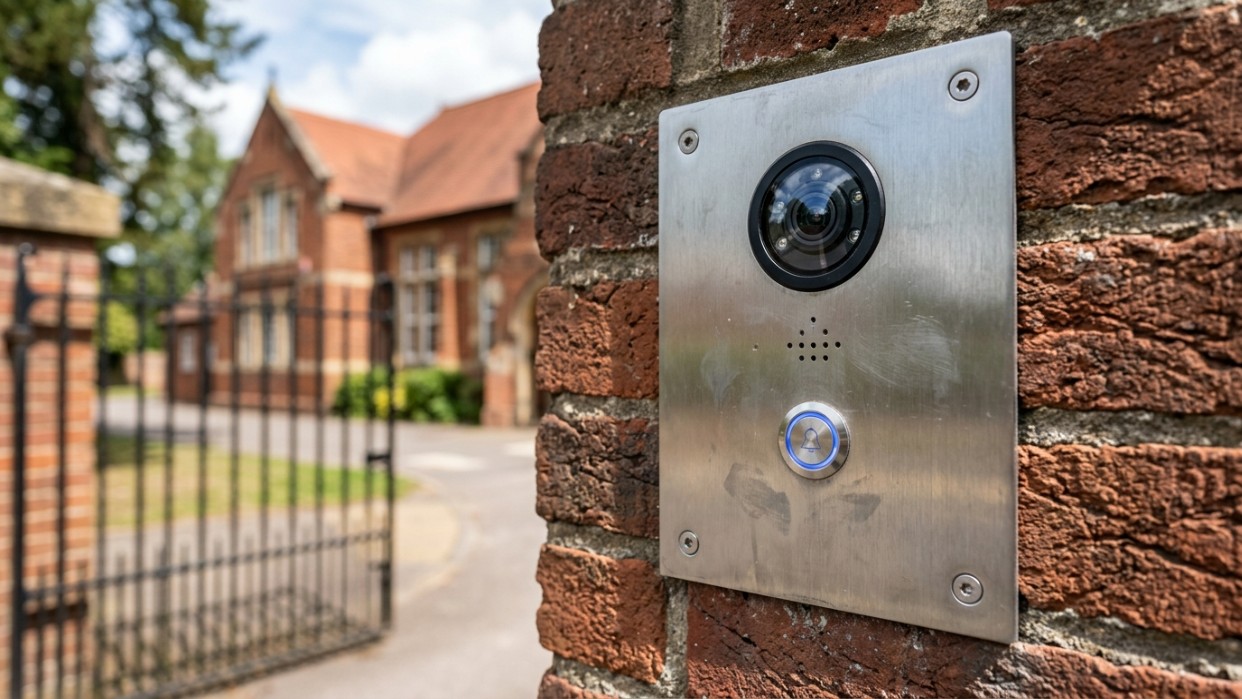
Weatherproofing is non-negotiable. Brisbane’s climate places significant stress on outdoor electronics, as covered in detail in our Intercom Brisbane Weather Guide. For school gate installations, a minimum IP65 rating is essential, and IK10 impact resistance is strongly recommended for any entry point accessible to students. Vandal-resistant stainless steel housings and recessed camera lenses significantly extend the service life of gate panels in educational environments.
Power redundancy matters more than most assume. A school entry system that fails during a power outage — precisely when security protocols are most likely to be activated — provides no protection at all. Specifying PoE switches with UPS battery backup ensures that entry panels, indoor monitors, and the network infrastructure supporting them remain operational during grid interruptions.
Staff training determines system effectiveness. The most sophisticated IP intercom system delivers no benefit if office staff are uncertain how to operate it under pressure. Consequently, any deployment should include structured handover training, laminated quick-reference guides at each indoor monitor, and a clear escalation process for system issues. This is consistently the element that separates successful school intercom deployments from frustrating ones.
Staged deployment is often the most practical approach for budget-constrained schools. Starting with the main pedestrian entry and office communication, then adding secondary entries and visitor management integration in subsequent budget cycles, allows schools to spread cost over time without compromising core security from day one.
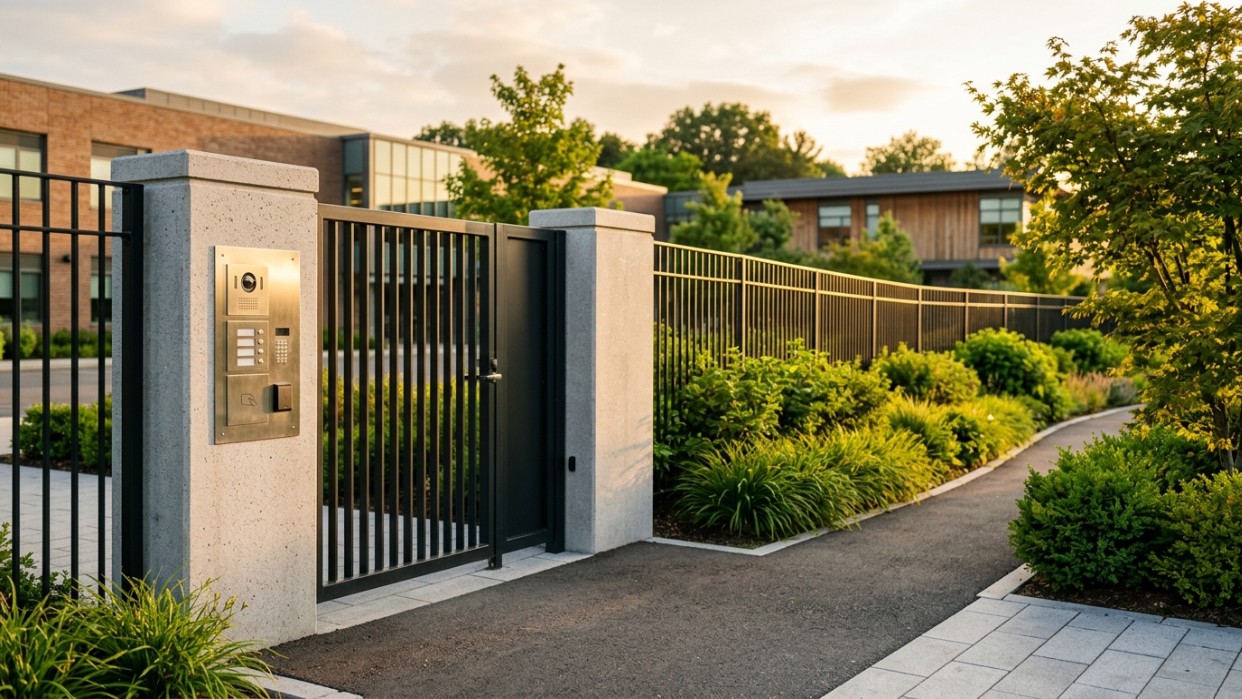
Choosing the Right Partner for Your School’s System
Specifying an intercom Brisbane system for an educational environment is not the same as selecting a residential or standard commercial solution. The access patterns, compliance requirements, emergency communication needs, and operational pressures of a school are distinct — and the system specification, installation approach, and post-installation support need to reflect that.
At Intercom Solutions, we work with Brisbane schools and educational institutions across South East Queensland to specify, supply, and install IP intercom systems that fit the real operational demands of campus environments. Whether you are replacing an ageing analogue system, extending coverage to secondary entry points, or specifying a new campus from scratch, we provide recommendations grounded in how Queensland schools actually work.
Contact us for an obligation-free consultation tailored to your campus size, entry configuration, and budget.